

Finding six: Collaborative learning teams score higher across 6 of 7 themes
If the two walls explain where teams get stuck, this section is about what gets them past one. Two separate cuts of the data point to the same conclusion: the levers that move maturity are about collaborative learning.
Before the data, a quick definition: what we mean by collaborative learning.
True organizational agility and sustained competitiveness are only achievable once every individual is actively contributing to the collective upskilling and reskilling effort.
Collaborative learning is the practice of learning with and from one another rather than waiting on training delivered top-down — L&D orchestrating the system and aligning it to business objectives, rather than running every piece of it alone; subject-matter experts creating and sharing what they know; managers catching skill gaps and folding upskilling into their own team's daily work; business leaders visibly sponsoring the effort and naming the skills that matter; and every employee flagging gaps, recommending experts, and feeding the catalogue back. Done well, it turns learning from a centralized function into a pervasive, business-driven capability, with internal expertise shared at the pace the business actually moves.
Now back to the two separate cuts of the data.
First, tooling.
Among firmographically-matched respondents (n=399), enabling scalable SME collaboration is foundational to reaching higher levels of L&D maturity. Adopters of systems that enable collaborative learning* score higher than non-adopters across all other maturity themes—led by Training Processes (2.88 vs. 2.49)—and achieve an overall average of 2.67 versus 2.50. Crucially, zero adopters sit at Level 1 maturity, while 62% reach Level 3 or higher (compared to 47% of non-adopters). While tooling doesn’t equal maturity, our hypothesis is that the right infrastructure enables everything else.
*As with every "collaborative learning approach" comparison in this report, adoption is operationalized as 360Learning customer status: 138 adopters against 261 non-adopters within the 399 enriched respondents. See Methodology.
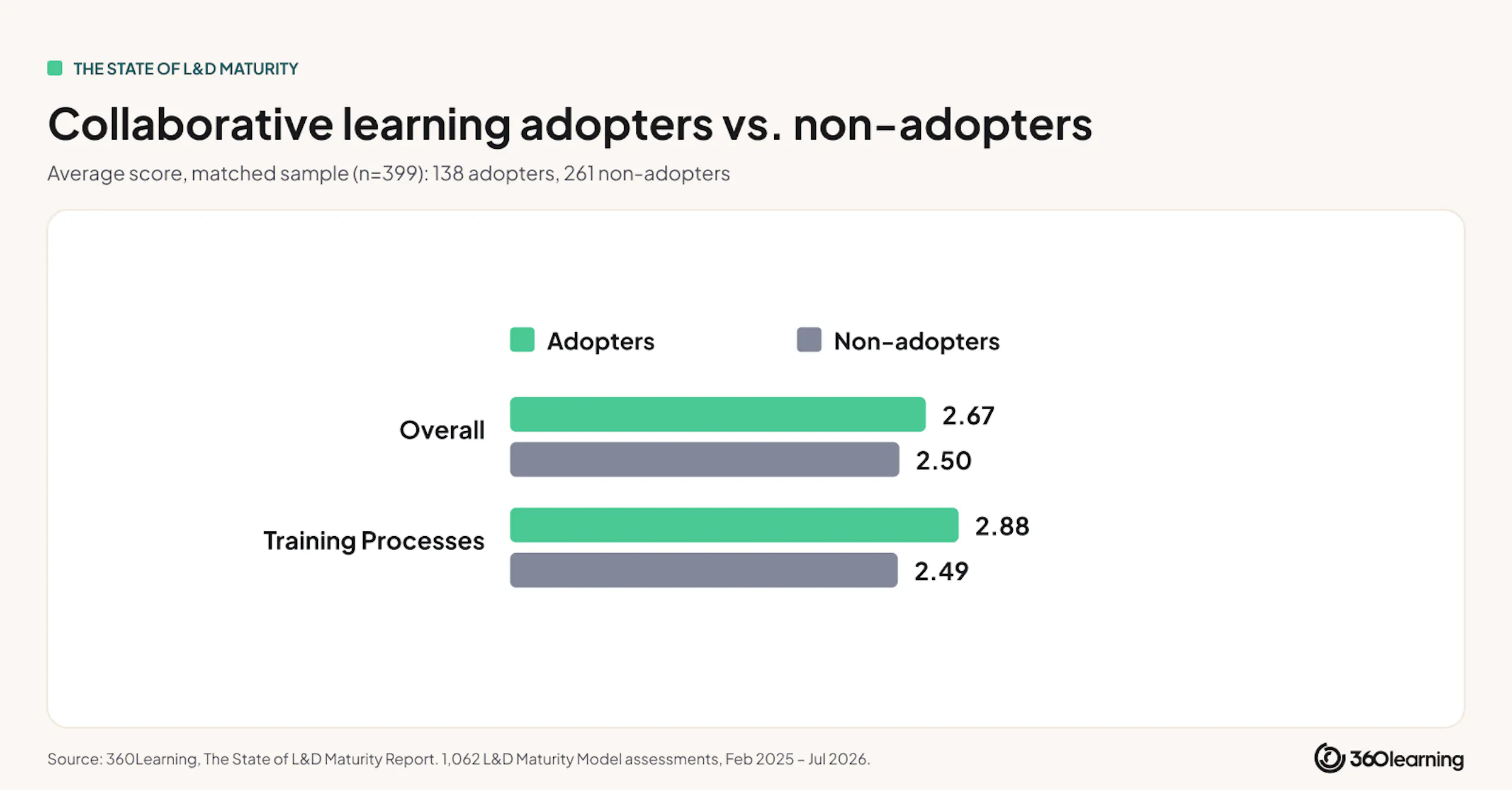
The same collaborative learning gap shows up when we compare the top and bottom quartile of the enriched sample (n=399), using every respondent at or beyond the 25th-percentile threshold on either end rather than an arbitrary top/bottom 10% cut.
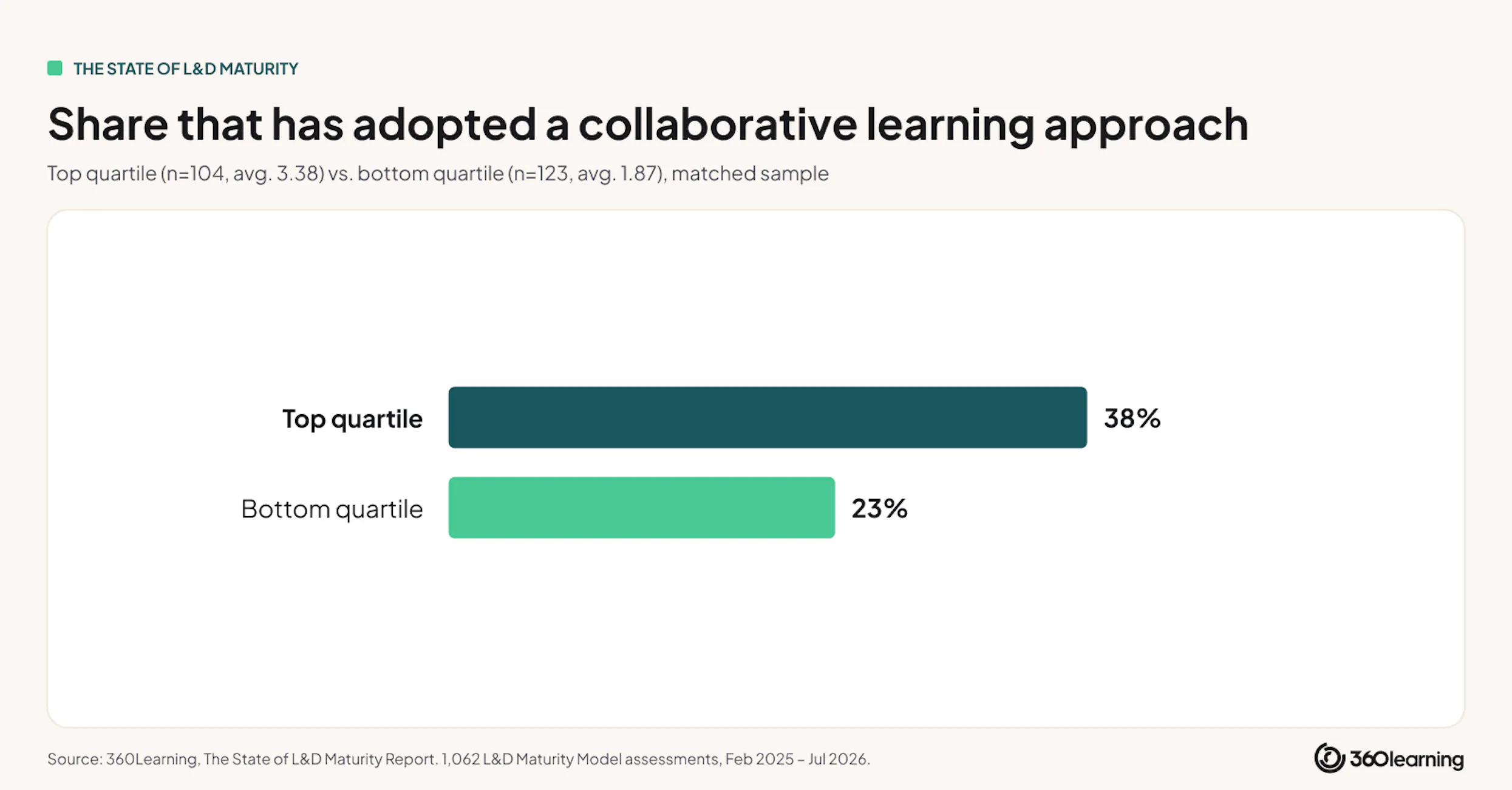
The top quartile (n=104, average score 3.38) is 1.6 times more likely to have adopted a collaborative learning approach than the bottom quartile (n=123, average score 1.87) — 38% versus 23%. The bottom quartile, in turn, is 1.5 times more likely not to have invested in a collaborative learning approach.
The two case studies below put that infrastructure gap into practice, at different scales: Heineken's shift to a co-authored, AI-assisted content model across more than 190 countries, and ArcelorMittal's system for scaling expert knowledge including turning one engineer's know-how into training used across the whole business.
L&D Maturity in Practice: Heineken
Heineken's L&D team operates across more than 190 countries and 85-plus operating companies, and used a shift to a decentralized, collaborative learning model to standardize brand values and product knowledge globally while letting local experts adapt content for their own retail markets. AI-assisted authoring and translation cut rollout times for new launches from months to days, giving local teams real-time updates ahead of product launches. The result: an 86% surge in learner engagement and more than 1,200 standardized courses deployed, replacing what had been fragmented, off-brand local content.
"360Learning empowers our local teams to work with SMEs. They [local teams] know their people best; they have the ability to identify, certify, and build relationships with their internal experts to capture and share knowledge locally." - Global Learning Experience Specialist, HEINEKEN
Read more about Heineken’s story
Identifying Learning Needs at scale: ArcelorMittal
ArcelorMittal, a global leader in steel production, needed to break down silos and rapidly share technical expertise across its worldwide operations. Its L&D team leaned on 360Learning’s Learning Needs feature that lets training demands surface directly from employee requests, rather than waiting for a central team to spot the gap. Benjamin Pyliser, a Maintenance Manager in Belgium, illustrates how that plays out in practice: after fielding repeated requests from peers about their SAP Maintenance Planning module, he built a single course within 24 hours. That one course became a global success story, leading to more than 59 courses created and over 9,000 enrollments across the business.
"It made it possible to share my knowledge around the world, around all the sites that needed those courses."
— Benjamin Pyliser, Plant Maintenance Operations Manager, ArcelorMittal
Read more about ArcelorMittal’s story
Secondly, organization size.
This is perhaps the most useful insight for any L&D leader working outside a large enterprise: none of this appears to depend on headcount. Comparing organization size within the enriched sample, Enterprise (10,000+ employees, n=74) averages 2.65 overall, Large (1,000-10,000, n=135) averages 2.54, and Mid-Market (500-1,000 n=178) averages 2.57 — a tight spread with no clear size hierarchy.
The one place Enterprise pulls meaningfully ahead is Learning Metrics, where it leads Mid-Market by 0.26 levels (2.62 vs. 2.36), almost certainly reflecting the data infrastructure that comes with scale. Everywhere else — strategy, alignment, learner engagement, processes — Mid-Market matches or, on SME Collaboration and Leadership Alignment, slightly exceeds Enterprise. (We exclude SMB from this comparison; at n=11 in the enriched sample, it's too small to draw conclusions from.)
The takeaway across the two cuts is consistent: the lever that separates high-maturity organizations from low-maturity ones — is adopting a collaborative learning approach. And it’s available to organizations of essentially any size. Maturity is a function of what you invest in, not how big you are.
Finding seven: Sector spotlights — where you sit shapes what's holding you back
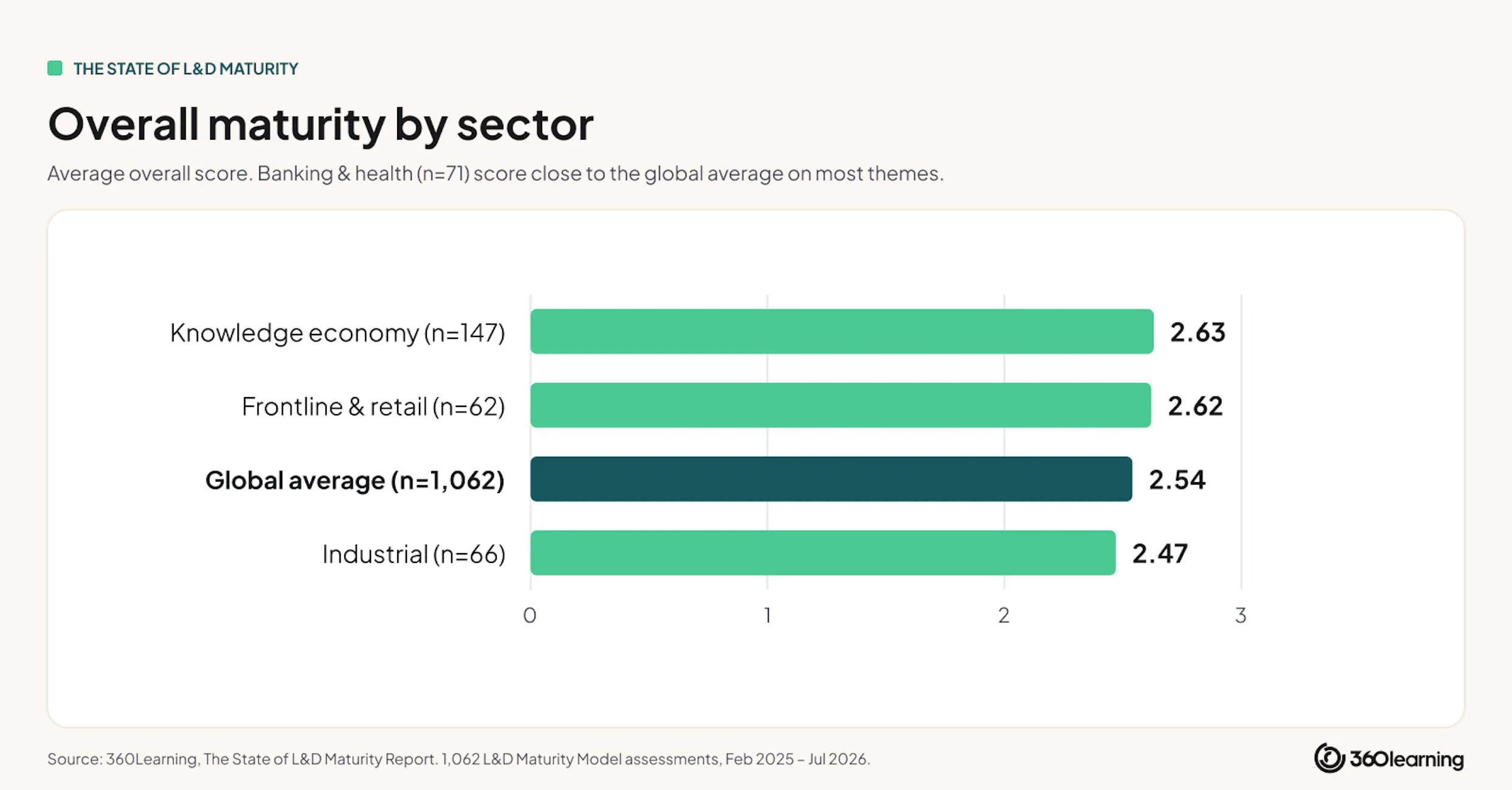
The same underlying gap — the plateau, the two walls — shows up differently depending on the industry a team sits in. This is a useful context for reading your own results against peers who face a similar operating environment.
Spotlight A: Frontline and Retail
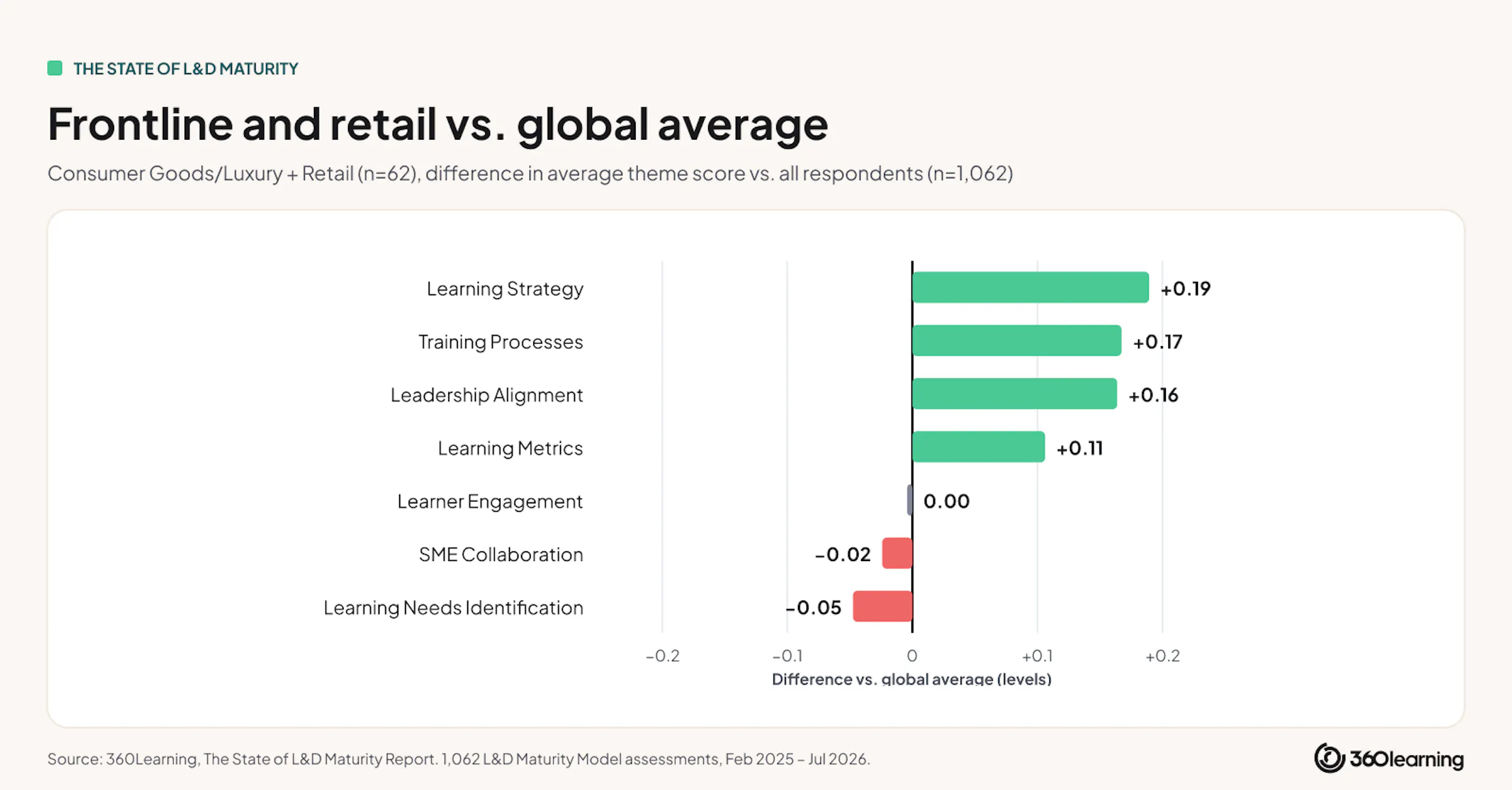
Frontline and retail organizations (n=62, combining Consumer Goods/Luxury and Retail respondents) over-index on precisely the themes that most of the industry struggles with: Learning Strategy (+0.19 versus the global average), Training Processes (+0.17), and Leadership Alignment (+0.16).
The two sub-sectors behind that number move together rather than pulling in different directions — both land within half a point of the group's 2.62 overall average — which is why we treat them as one story rather than two. The likely explanation is that training in these sectors has an undeniable, visible line to revenue: brand consistency, customer experience, and sales performance are all directly downstream of how well frontline staff are trained, which makes the strategic case for L&D easy to make and even easier for leadership to back.
The three case studies below put a face on that pattern at three different scales: Louis Vuitton's globally-architected luxury retail model, Heineken's centralized-but-local frontline execution, and BABOR's mobile-first approach builds for a workforce with no fixed desk.
A globally architected learning strategy: Louis Vuitton
Louis Vuitton, part of LVMH, runs learning across retail, industrial, and corporate operations for a global workforce, covering onboarding, frontline retail training, compliance, and sales enablement. Its Global Learning team operates as a "Learning Center of Expertise," driving content production, curation, and deployment through Louis Campus, its branded learning platform, while coordinating with local Chief Learning Officers across each Maison. It's the kind of centrally-owned, strategically-architected model that shows up in the numbers as the sector's +0.22 Learning Strategy lead: learning run as a coordinated global function rather than a local afterthought.
"With the architecture of our Louis Campus learning platform, we've created a real playground for our teams. By assigning them local groups, we empower them to design their own training content and engage their local communities. At a global level, our role is to promote the platform, orchestrate the overall experience, provide guidelines for our learning community experts, and ensure high standards for content and data quality. The goal: give learners seamless access to top-tier training on a platform tailored entirely to Louis Vuitton's brand identity."
— Maxime Cognacq, Global Digital Learning Manager, Louis Vuitton
Centralized standards, local execution: Heineken
Heineken's decentralized model (introduced in finding six) is as much a frontline-training story as a tooling one: global consistency comes from centralized certification on brand values and product knowledge, while local experts adapt content for regional retail markets without diluting the core message.
That combination — centralized standards, local execution — is a working example of the sector's Leadership Alignment lead (+0.18): leadership and L&D pulling in the same direction on what "on-brand" training means, even when the day-to-day execution is local. It's also what let the team translate global brand strategy into hands-on, blended learning that frontline staff could apply immediately in daily customer interactions, contributing to the 86% engagement surge referenced earlier.
Training in your pocket: BABOR
BABOR is a third-generation, family-owned skincare company selling in more than 70 countries, where consistency depends entirely on its beauticians and beauty experts — a genuinely frontline, deskless workforce advising clients directly in stores and treatment rooms, with no fixed workstation and little time for classroom training. BABOR built its training strategy mobile-first from the ground up to reach them. Within six months of launch, and without adding headcount, its eLearning team deployed 300 courses and 100 learning paths, now used by more than 2,000 learners, reaching an 89% completion rate — the kind of operational execution behind Retail's sector-leading 2.86 on Training Processes.
"Our trainees now have the opportunity to learn everything about BABOR and our product worlds 24/7. Quite literally: 'BABOR in a pocket.'"
— Nathalie Mies, eLearning Manager, BABOR
Spotlight B: Compliance-heavy and regulated industries: Banking + Health
As covered in finding four, banking and health organizations (n=71) score close to the global average on most themes but show the largest single sector-level gap in the dataset on Learning Needs Identification (−0.19) — the sharpest version of the mechanism described there, where compliance mandates set the training agenda well before anyone asks what people actually need to learn.
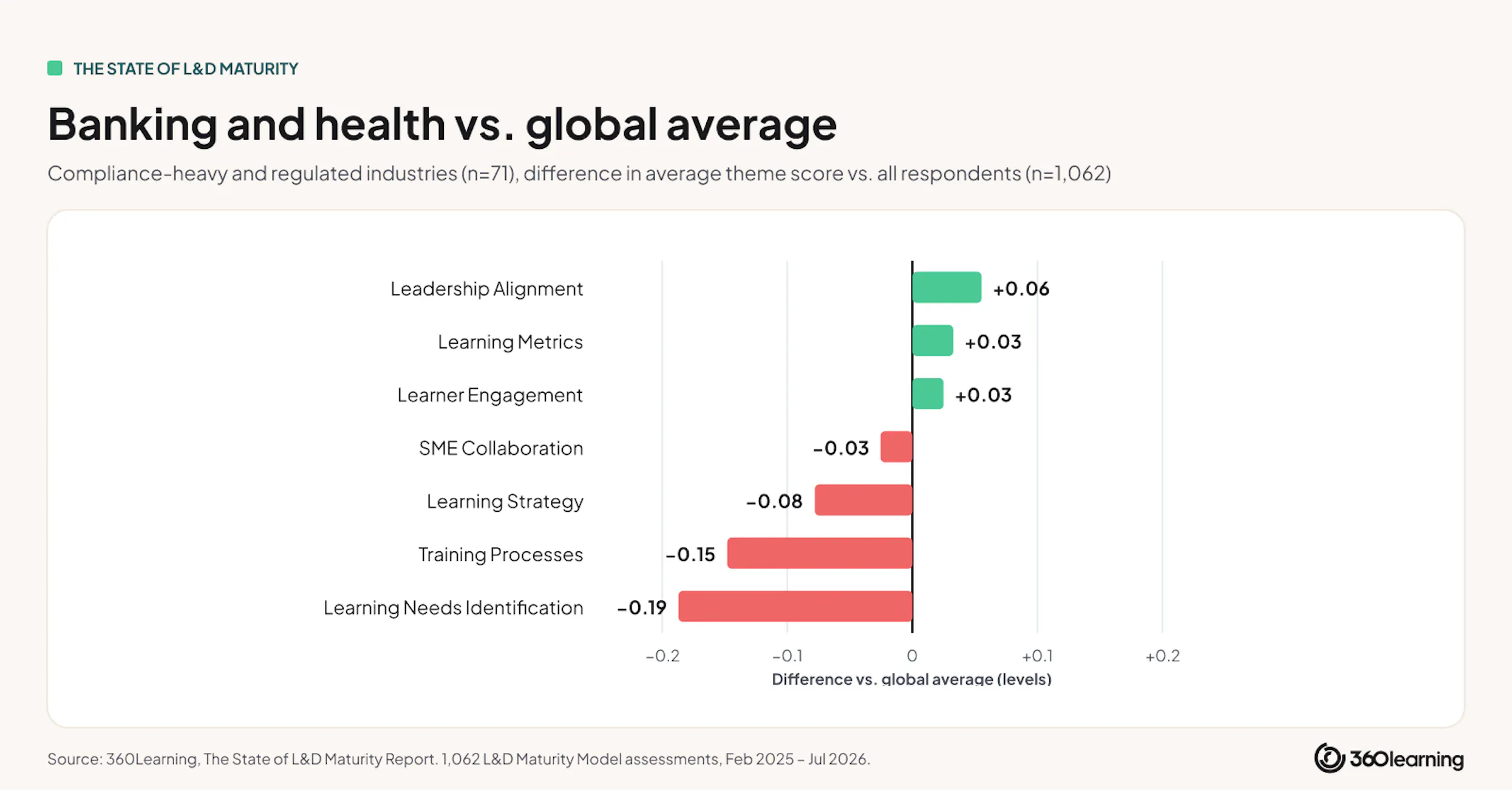
Vygon's case study below shows what closing that gap looks like: a strategy rebuilt around listening to what employees are asking for — without sacrificing the compliance rigor these sectors depend on.
Employee-led learning strategy: Vygon
French medical device manufacturer, Vygon (2,800 employees, 26 subsidiaries) overhauled its centralized L&D strategy to support employee growth, management competencies, and business transformation.
Key implementation and impact
- Unified platform: Standardized training across 26 subsidiaries and 50+ distributors via its single platform, Academix.
- Co-creation: Engaged 56 internal co-creators in 2025 to build targeted content around expressed employee needs.
- Strong engagement: Reached 3,000 active users and delivered 546 total days of training.
- High satisfaction: Achieved an NPS of 63 and a 98% module relevance rating by shifting focus from pure compliance to skill progression.
Spotlight C: Knowledge economy: Tech, Services, Consulting & Media
Knowledge-intensive industries (n=147) led the dataset overall (2.63 vs. 2.54 global average), driven by strong performances in Training Processes (+0.21) and SME Collaboration (+0.12). Organizations in this sector scale learning by pairing operational workflows with systematic expert-led content creation.
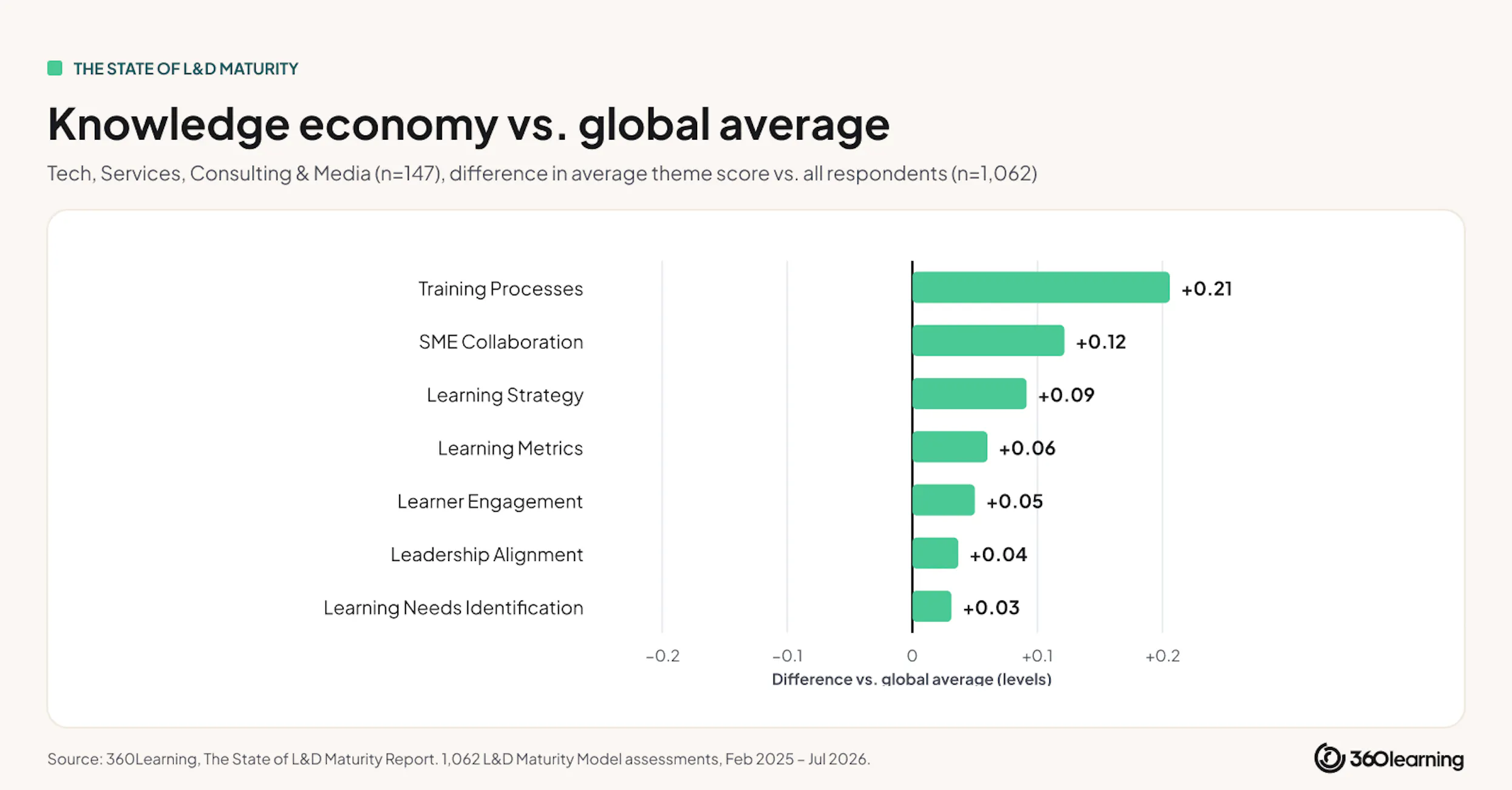
The two case studies below show what that second half looks like. Partoo's deliberate process for identifying and engaging the experts behind that SME Collaboration lead, and Croud's platform for turning its network of specialists into content creators at scale.
Finding subject-matter experts: Partoo
Partoo, a Paris-founded B2B SaaS company that helps local businesses and multi-location brands manage their online presence and customer relationships across more than 300,000 points of sale globally, has built a deliberate process for finding and engaging subject matter experts rather than leaving it to chance — the kind of intentional practice behind the sector's SME Collaboration lead.
"At first, we set out to identify the most communicative team members. It's relatively easy to spot those who naturally speak up, share what they've read, and have a genuine passion for passing on their expertise and learning together. Naturally, these are the first people we turn to when looking for ambassadors to create content for us. At the same time, we keep an ear to the ground to see who is facilitating internal workshops or sharing debriefs during meetings. This helps us pinpoint individuals who are motivated, enthusiastic, and comfortable in front of an audience. From there, it's about finding the right balance between identifying these profiles and determining how they can best contribute." — Claire Michelizza, Learning & Enablement Senior Manager, Partoo
Turning a freelance network into content creators: Croud
Digital marketing agency Croud (500+ employees, 2,400+ freelancers) replaced its fragmented Google Drive training materials with Croud Campus, a centralized 360Learning hub designed to scale internal expertise.
First-year results
- Scalable creation: Empowers SMEs to build content, resulting in 1,588 courses and 230 learning paths.
- Widespread delivery: Reached 2,000+ learners with 142 total days of training.
- High satisfaction: Achieved a 99% positive reaction score across 50,000+ learner responses.
Spotlight D: Industrial: Manufacturing, Automotive and Agriculture
Industrial L&D (n=66) sits slightly behind global benchmarks—scoring an overall 2.47 against the 2.54 average—while maintaining solid baseline parity in core operational areas like Training Processes and SME Collaboration. Rather than indicating a structural defect, this minor gap highlights an immediate opportunity to elevate established training operations into tighter strategic alignment.
With a proven track record of managing large, deskless workforces, industrial organizations already possess the necessary operational reach. The next evolution is directly connecting that infrastructure to key business drivers—such as operational efficiency and performance.
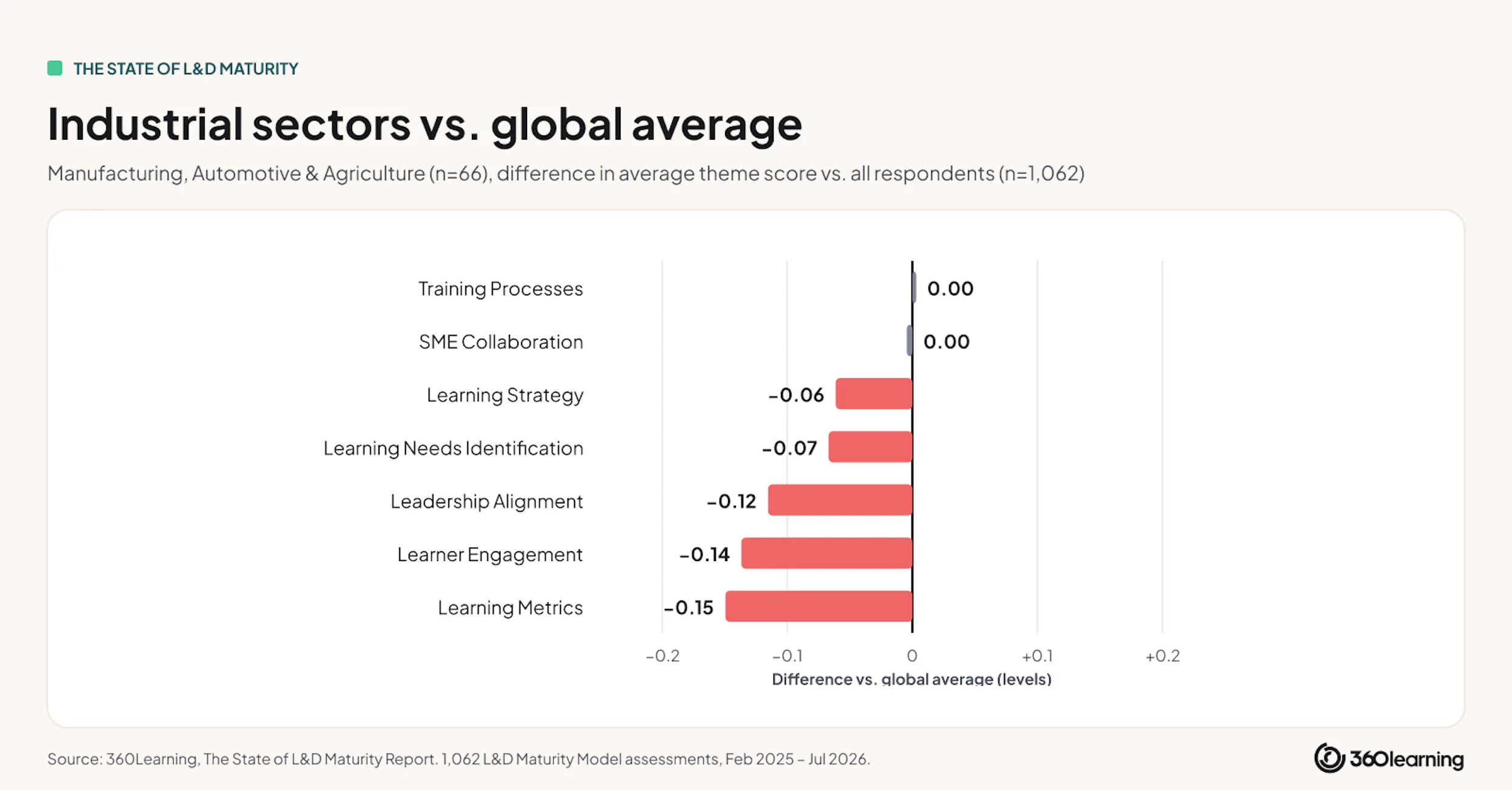
The two case studies below illustrate this transition in action: building on a dependable operational base to unlock deeper, strategic business impact.
Turning foundation into strategy: Adisseo
Adisseo (2,700+ employees, 110+ countries) proves that a distributed, deskless workforce is no barrier to building a high-performing L&D function. Having already established solid, proactive training operations, the company is now connecting that base directly to business priorities like operational excellence, safety, rapid skill development, and knowledge retention as staff retire. Adisseo demonstrates that an L&D function's strategic impact isn't limited by workforce structure, but earned through strategic alignment.
Read more about Adisseo's story
From spreadsheets to a system that surfaces needs: Ishida
Ishida is the leading manufacturer of weighing and packaging equipment for the global consumables market, with more than 3,500 employees across the world. They transformed its L&D function from reactive spreadsheets to a proactive, system-driven strategy across its 3,500-person global workforce.
Core pillars
- Expert-Led Authoring: Frontline engineers build role-specific technical content.
- Automated Enrolment: Assignments and renewals trigger automatically by role, location, and certificate expiry.
- Structured Skill Mapping: Competencies and rubrics map directly to skill gaps and career paths.
- Centralized Compliance: Real-time dashboards unify L&D, health, and safety data.
Key results
- 52% reduction in L&D administrative overhead
- 30% increase in compliance rates
- 40 hours saved monthly on manual reporting
- Reduced turnover through formal career pathways, particularly in field and sales roles
Read more about Ishida's story
Next chapter: What to do next: Six moves that get you off the plateau
 Our weekly newsletter of the best insights from L&D peer to L&D peer.
By providing your contact info, you agree to receive communications from 360Learning. You can opt-out at any time. For details, refer to our Privacy Policy.