
Discover the learning platform powered by collaborative learning.

A 15-minute discussion with an expert

100% tailored to your needs - with ❤️

No commitment. Free as can be.

Updated on
360Learning and Cornerstone OnDemand are established leaders in the enterprise learning market. And they’re a frequent point of comparison for organizations evaluating modern learning platforms.
Each offers extensive capabilities for large-scale learning programs, supports skills development initiatives, and continues to expand its AI-powered functionality for workforce development.
But at their heart, they solve different problems.
Cornerstone's roots are in talent management. Learning sits alongside recruiting, performance management, succession planning, workforce development, and skills intelligence.
360Learning helps you close skills gaps by unlocking the rich expertise already inside your organization. Learning shouldn’t be a top-down process, so the platform enables subject-matter experts across the business to create, improve, and share knowledge directly.
These differences influence everything from content creation and learner engagement to AI strategy, administration, and long-term adoption.
This guide compares the two platforms across the capabilities that matter most to enterprise buyers. Where Cornerstone leads, we'll say so. Where 360Learning has an advantage, we'll explain why.
By the end, you'll have a clear picture of which platform aligns best with your organization's learning strategy—not just its technology requirements.
A 15-minute discussion with an expert
100% tailored to your needs - with ❤️
No commitment. Free as can be.
By providing your contact info, you agree to receive communications from 360Learning. You can opt-out at any time. For details, refer to our Privacy Policy.
It's worth understanding the different philosophies behind these two platforms. Although they often appear in the same enterprise LMS lists, they’re built to solve different challenges.
360Learning is the AI-driven enterprise LMS that closes skills gaps by capturing internal expertise through collaborative learning. The platform combines enterprise LMS and LXP capabilities with agentic AI, adaptive coaching, collaborative learning workflows, and a multimodal AI content builder.
The most valuable expertise in your business doesn't live inside an LMS. It lives with the people doing the work every day. So rather than relying exclusively on L&D teams to create training, 360Learning lets subject-matter experts throughout the organization contribute knowledge directly.
AI Course Builder helps you create content from documents, URLs, and prompts, while AI Companion assists with refinement, structure, and quality. Discussions, comments, and reactions create continuous loops to keep content accurate and relevant as the business evolves.
Today, more than 2,500 organizations like Heineken, Michelin, Cisco, Equinox, ArcelorMittal, and Merlin Entertainments use 360Learning to scale learning across employees, customers, and partners. The platform is an SAP PartnerEdge Build Partner and Workday Silver Innovation Design-Badge Partner.
Founded in 1999, Cornerstone OnDemand is a talent management suite that spans recruiting, onboarding, learning, performance management, succession planning, and workforce development.
Learning is a major part of that platform. But it sits within a broader talent ecosystem rather than acting as the primary focus.
For organizations pursuing HR technology consolidation, this can be an attractive proposition. Rather than managing separate systems for learning, performance, and talent development, leaders can bring these functions together within a single vendor relationship.
The trade off is that learning becomes one component of a much larger platform.
As a result, buyers evaluating Cornerstone are often assessing more than an LMS. They're evaluating whether a broader talent management suite aligns with their long-term HR and workforce strategy.
In many areas, Cornerstone and 360Learning overlap significantly. But in others, they reflect fundamentally different assumptions about how learning should be created, delivered, and improved.
The right choice ultimately depends on whether your priority is managing learning within a broader talent ecosystem or building a learning ecosystem that can evolve with your business.
This is arguably the clearest functional distinction between the two platforms. 360Learning has powerful AI content authoring capabilities; Cornerstone Learning has no native authoring tool.
For enterprise organizations, this difference is important. Knowledge evolves quickly, subject-matter experts are busy, and L&D teams rarely have enough capacity to keep every course up to date. So your ability to create and update learning materials quickly — and without routing everything through a central L&D team — can make or break your training program.
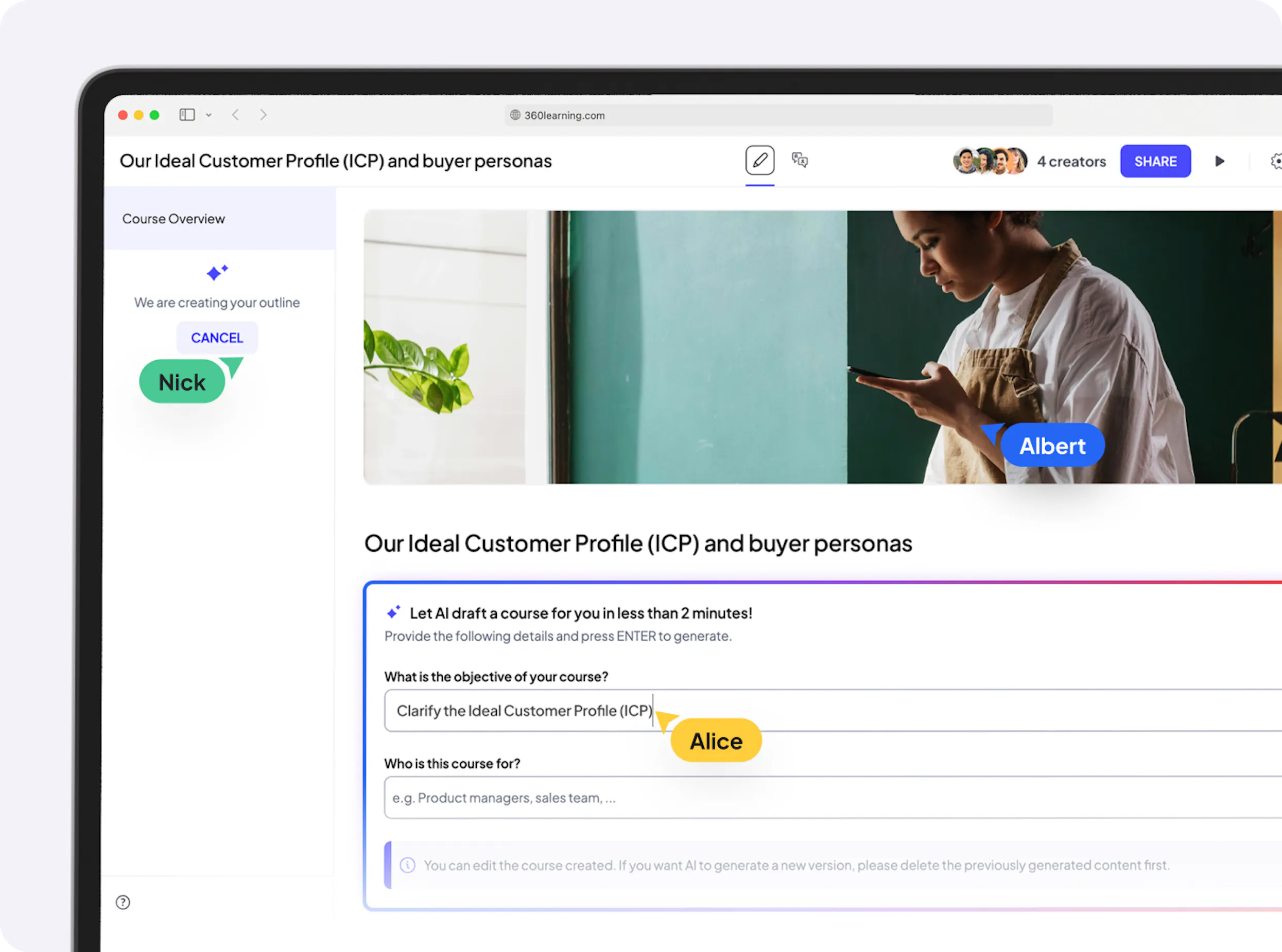
Cornerstone puts L&D in charge of all content creation. 360Learning empowers your subject-matter experts to create it, with L&D maintaining full oversight.
Both platforms have invested heavily in AI, but priorities differ considerably. So the critical question is how AI actually improves the learning experience for administrators, content creators, managers, and learners.
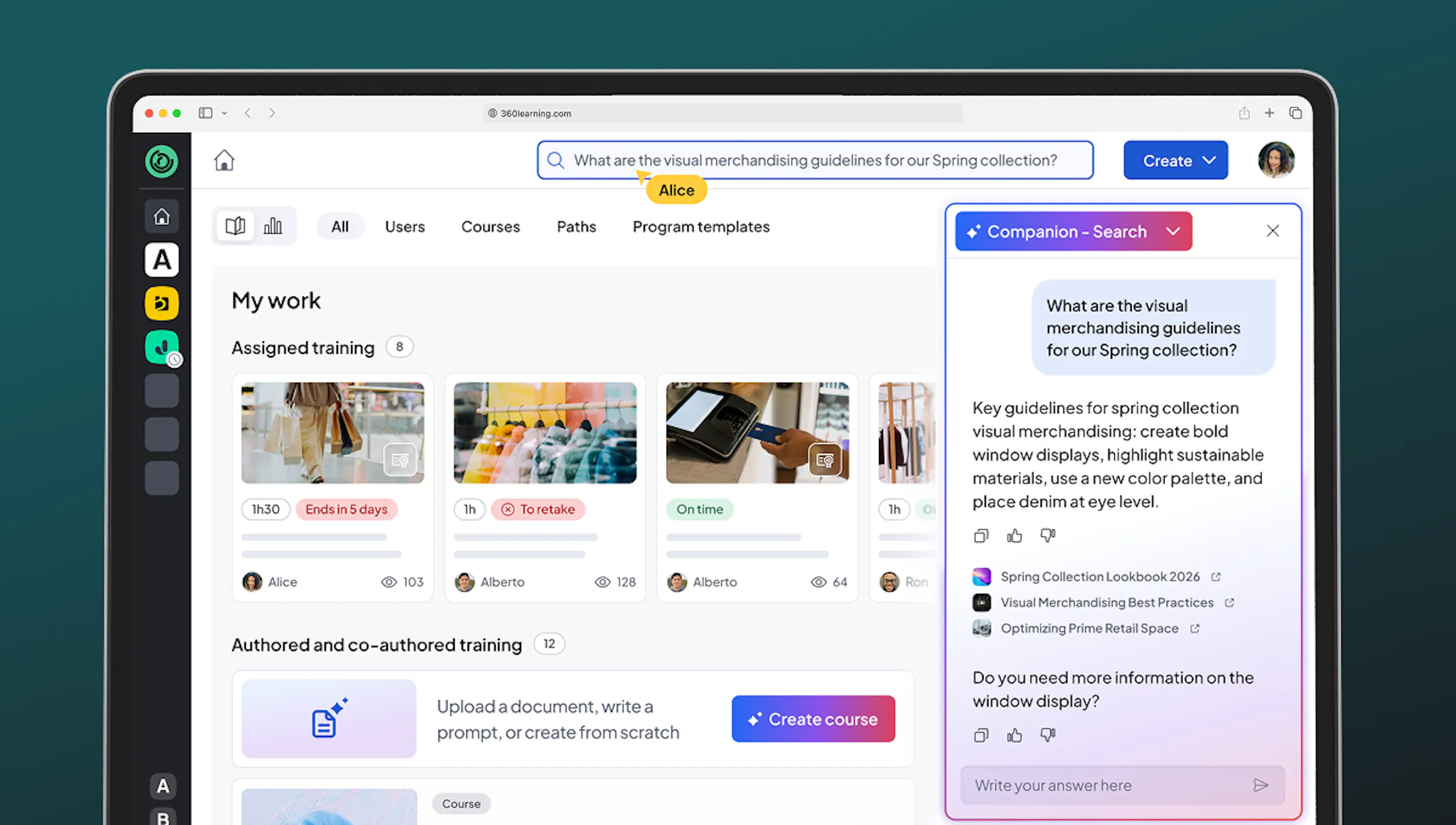
Cornerstone's AI strategy is primarily focused on workforce intelligence. It helps you understand skills, identify talent opportunities, and support broader workforce planning initiatives.
360Learning's AI strategy is focused on learning acceleration. You create content faster, improve learning quality, coach employees more effectively, and close skills gaps through ongoing development.
User experience remains one of the strongest predictors of learner adoption, administrator satisfaction, and long-term platform success. This is particularly important for organizations with lean L&D teams that don't have dedicated specialists available to manage complex systems.
The trade-off is breadth versus usability. Cornerstone offers extensive configuration options and enterprise controls, but the platform can require a specialist just to operate effectively. For L&D teams, that depth becomes a liability: features go unused not because they're not needed, but because they're too difficult to set up and maintain.
360Learning prioritizes usability, intuitiveness, and speed. These reduce the friction from creating content, engaging learners, and managing learning programs.
Ultimately, the best learning platform is the one people actually use. And user experience often determines whether that happens.
Sales reps need to deliver pitches. Customer success teams need to conduct product demonstrations. Managers need to navigate difficult conversations. Service teams need to communicate effectively with customers.
Most learning platforms are designed to transfer knowledge. Far fewer are designed to help people practice skills.
For organizations where employees must demonstrate skills rather than simply understand concepts, opportunities for practice become critical. Coaching workflows create a bridge between learning and performance that traditional LMS experiences often struggle to provide.
Skills are a strategic priority for most modern organizations. But there are two very different ways to approach the challenge.
One focuses on understanding workforce capabilities and future talent needs. The other helps employees develop skills more effectively in the flow of learning.
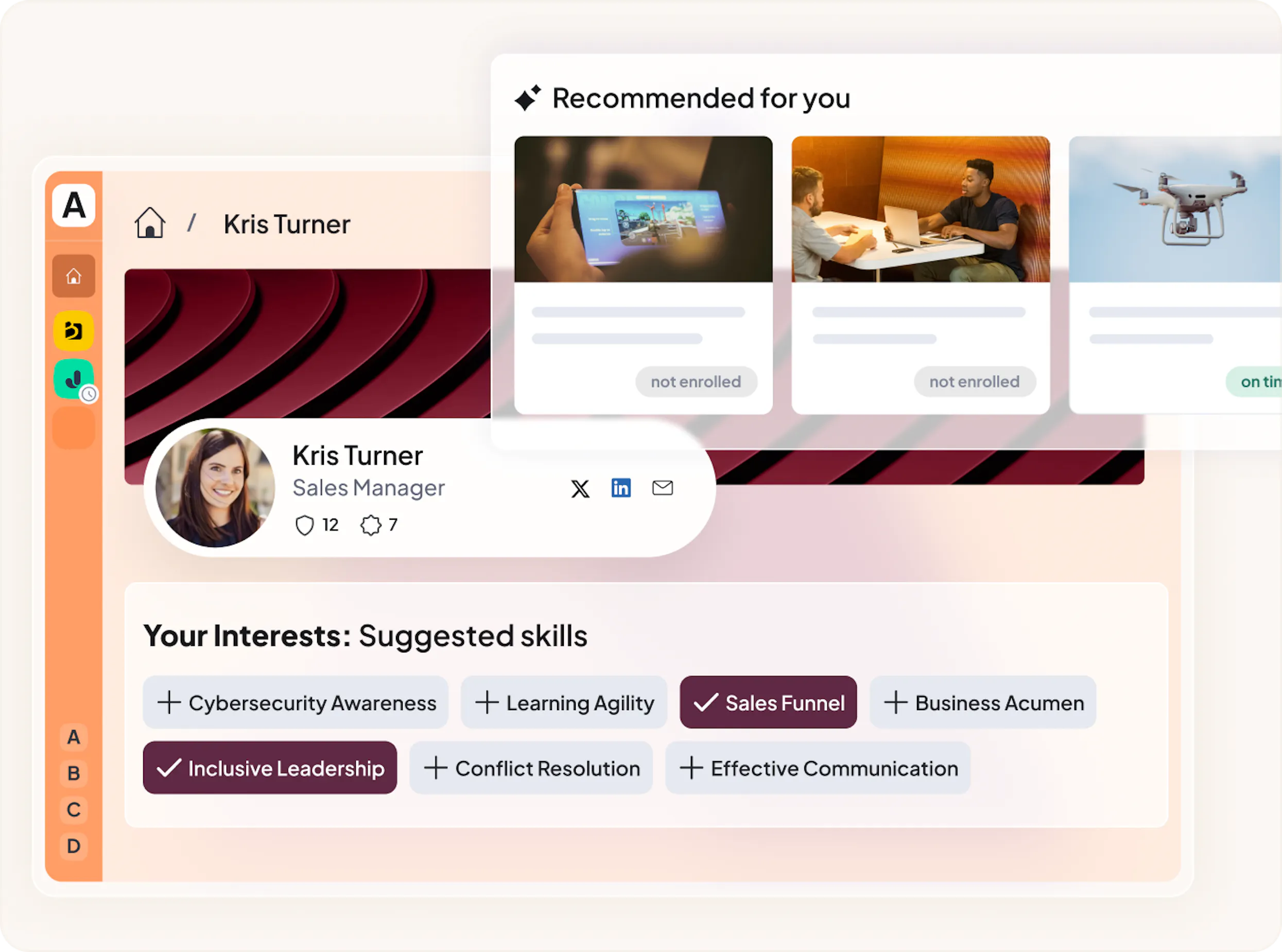
Cornerstone approaches skills as a workforce planning challenge. Its strengths lie in visibility, talent mobility, succession planning, and helping organizations understand capability gaps across large populations.
360Learning sees skills development as central to learning. It helps employees develop faster through expert-led learning, collaboration, coaching, and continuous feedback.
This is one area where Cornerstone's comprehensive suite can be an advantage. Many organizations operate in highly regulated environments where compliance tracking, certification management, audit readiness, and governance controls are among the most important requirements for a learning platform.
360Learning handles compliance training and monitoring very well, but this is not the primary mission. So if you care most about ticking this box through rigid, standardized course materials, you won’t get full value from the platform.
Both platforms deliver strong support for highly regulated industries and large global organizations.
Organizations managing tens of thousands of employees, complex regulatory requirements, and highly structured governance models may value the depth and control that comes with a large-scale platform. For these organizations, learning is not just about development. It's also about risk management.
Selecting an LMS is only the beginning of your journey. The quality of implementation, onboarding, training, and ongoing support often has a greater impact on long-term success than individual platform features. Even the most capable technology will struggle to deliver value if organizations can’t get help when they need it.
The two support and setup processes don’t really compare. Cornerstone's support model reflects the complexity of the broader platform. Organizations frequently rely on dedicated administrators, implementation partners, or specialist resources to configure and maintain the system effectively.
360Learning is a true partner that helps organizations design and refine their learning environment. Per Gartner’s listings, 360Learning easily wins on “timeliness of vendor response” (4.8/5 vs 4.1/5), and “quality of technical support” (4.8/5 vs 4/5). G2 states that “users value the exceptional customer support from 360Learning, ensuring a smooth onboarding and ongoing assistance.”
Enterprise learning platforms don’t work in isolation. They connect with HR systems, collaboration platforms, identity providers, CRM solutions, content libraries, and business intelligence tools.
Both Cornerstone and 360Learning have mature partner integration ecosystems. Their priorities, however, reflect their broader product philosophies.
The difference here is less about connectivity and more about architecture. And neither approach is inherently better. The right choice depends on whether your organization prioritizes suite consolidation or specialized learning capabilities.
By this point, a pattern should be clear:
As a result, the best choice depends less on individual features and more on the outcomes your organization is trying to achieve.
Both platforms are designed for organizations that view workforce development as a business priority. The key difference is where they believe the greatest value comes from—and how they help organizations create it.
Do you want learning to be one component of your talent ecosystem, or the engine that drives workforce capability?
Book a demo of 360Learning to see how collaborative learning can help your organization turn expertise into measurable business impact.
A 15-minute discussion with an expert
100% tailored to your needs - with ❤️
No commitment. Free as can be.
By providing your contact info, you agree to receive communications from 360Learning. You can opt-out at any time. For details, refer to our Privacy Policy.
Is Cornerstone OnDemand primarily an LMS or a talent management platform?
Which platform is easier for lean L&D teams to manage?
How do the platforms differ in their approach to skills?
Which platform is better for change management and organizational transformation?
Can both platforms support global organizations?
What should buyers evaluate beyond the feature list?
 Our weekly newsletter of the best insights from L&D peer to L&D peer.
By providing your contact info, you agree to receive communications from 360Learning. You can opt-out at any time. For details, refer to our Privacy Policy.