Get your free demo
See how 360Learning can work for you.
A 15-minute conversation with an expert, fully tailored to your needs. No commitment, completely free.
Updated on
At 360Learning, we've always believed that AI should be in service of L&D impact, with the highest standards of security and quality built in. And with the rapid rise and adoption of AI tools, Model Context Protocol (MCP) has the potential to become one of the most important shifts in enterprise learning software this year. With an MCP server, AI assistants like ChatGPT, Claude, Gemini, Microsoft Copilot, or SAP Joule can connect directly to your business tools, including your LMS.
With the rapid rise and adoption of AI tools, Model Context Protocol (MCP) has the potential to become one of the most important shifts in enterprise learning software this year.
For learners, that means the ability to ask questions like "What learning should I prioritize this week?" and get an answer grounded in their actual skills and training data. For an admin, it means queries like "Our sales team hasn’t been able to improve their win rate against Acme Corp., how can I help?” will surface real-time training completion data and content analysis within their AI assistant.
These two examples are only scratching the surface of what will become possible over the coming months and years. That’s why every major LMS vendor is moving to support MCP. But few are talking about what it actually takes to get this right in an enterprise environment where the stakes are real, the data is sensitive, and your training infrastructure is a vital asset to your operations–not an experiment.
We’re building our MCP capabilities as genuinely enterprise-ready with a focus on performance, resilience, and security before customers begin using it.
At 360Learning, we've been designing our MCP capabilities since late 2025. While we’re excited to launch MCP support in Q3 2026, we’re not racing to announce features. We’re building our MCP capabilities as genuinely enterprise-ready with a focus on performance, resilience, and security before customers begin using it. We think this deliberateness is exactly what enterprise L&D teams should demand from their vendors.
Here's why.
MCP is an open standard, originally developed by Anthropic, that defines how AI assistants connect to external data sources and tools. Think of it as a universal adapter: instead of every AI tool needing a custom integration with every enterprise system, MCP provides a common protocol. Build one MCP server, and any compatible AI assistant can connect to it.
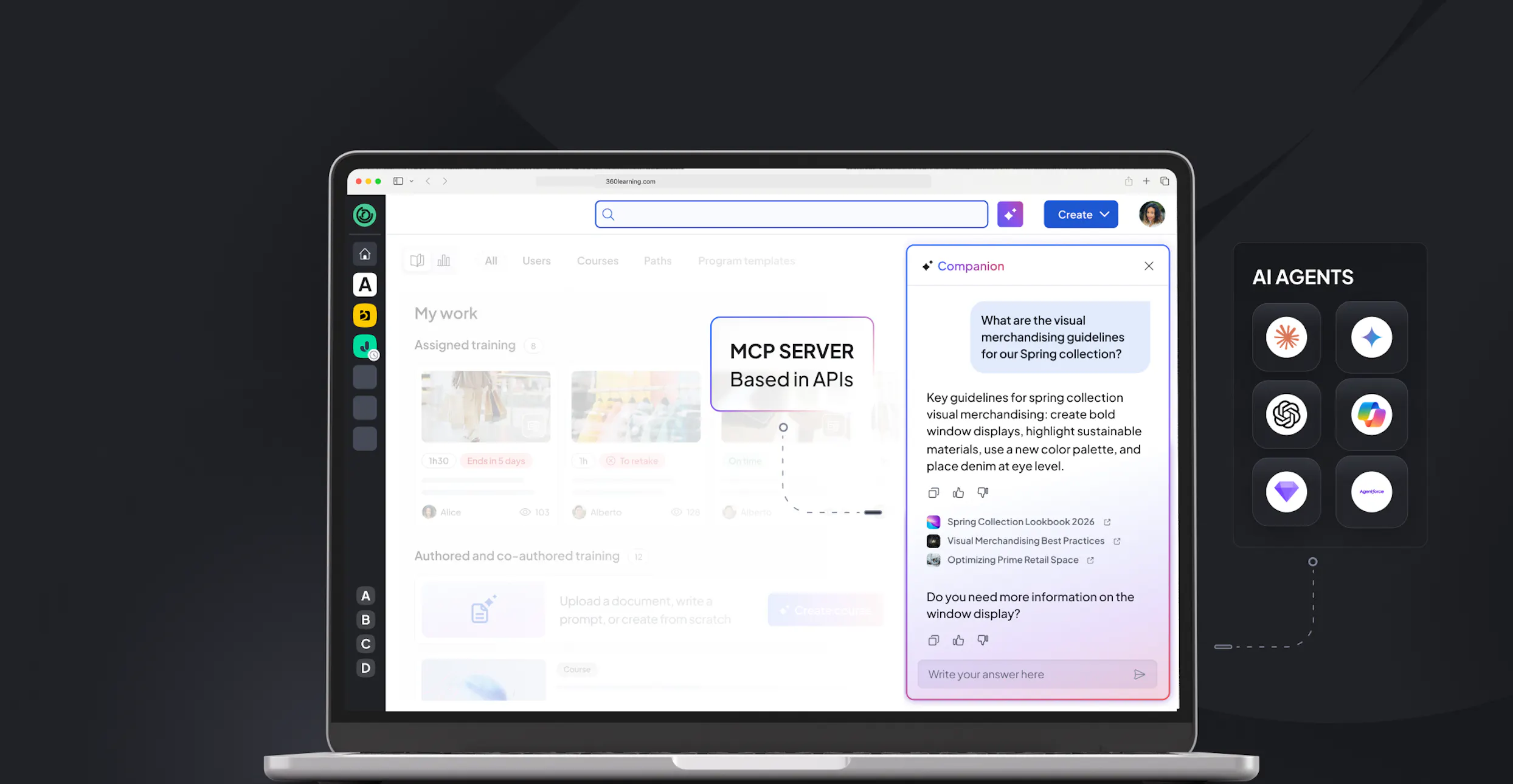
This is a substantial architectural shift. Before MCP, connecting an AI assistant to your LMS meant custom API work, months of development, and ongoing integration maintenance. MCP reduces that to a standard protocol: one server, many clients.
But MCP is a technical asset, not an outcome in itself. What matters is the capabilities it unlocks. Hype aside, it’s important to understand that an MCP server doesn't just read data. It can also write it. And in an LMS, "write" means enrolling learners, modifying groups, updating records, even deleting users. Each of these capabilities unlocks real value and carries real risk. Give an AI agent unrestricted access to those capabilities, and you've handed a non-deterministic system the keys to your training infrastructure.
But MCP is a technical asset, not an outcome in itself. What matters is the capabilities it unlocks.
That's why we are transparently sharing how we’re approaching MCP: which capabilities we’re unlocking and the guardrails that come with them. We believe this deliberateness and transparency is what enterprise customers need to implement MCP with confidence.
Large language models are, by nature, non-deterministic. Ask the same question twice, and you might get two different responses. That's fine when the task is drafting a course outline. It's not fine when the task is bulk-enrolling 1,000+ employees to the right compliance program based on their tenure, geographic location, and management level.
Our API platform includes more than 150 endpoints, many of which perform sensitive write operations: bulk user additions, group deletions, content modifications. These exist because enterprise customers need programmatic ways to interact with their learning data, setting up API-based workflows to leverage raw data directly or achieve use cases not natively available in our product. But exposing them to an AI agent without safeguards is a liability. Getting those safeguards right is precisely the work that makes an MCP server enterprise-ready.
At 360Learning, our MCP initiative is organized around the value it unlocks for three groups: learners, admins, and the subject-matter experts and authors who contribute to learning content.
At 360Learning, our MCP initiative is organized around the value it unlocks for three groups: learners, admins, and the subject-matter experts and authors who contribute to learning content. Each audience interacts with learning content and data differently, so each has its own approach to capabilities, authentication and guardrails. This reflects our commitment to balance innovation with enterprise-grade reliability.
This is where MCP delivers immediate, tangible value. A learner’s AI assistant can surface relevant training content from your LMS within ChatGPT, Claude, Gemini, Microsoft Copilot, Salesforce AgentForce or SAP Joule without the learner ever switching contexts.
For example, a learner prompts their AI assistant with: “I just lost two deals to Acme Corp. Help me get up to speed on Acme Corp and how we differentiate” and the response will surface relevant content covering the mentioned competitor. Learning is delivered in the moment of need without the learner needing to search a separate system.
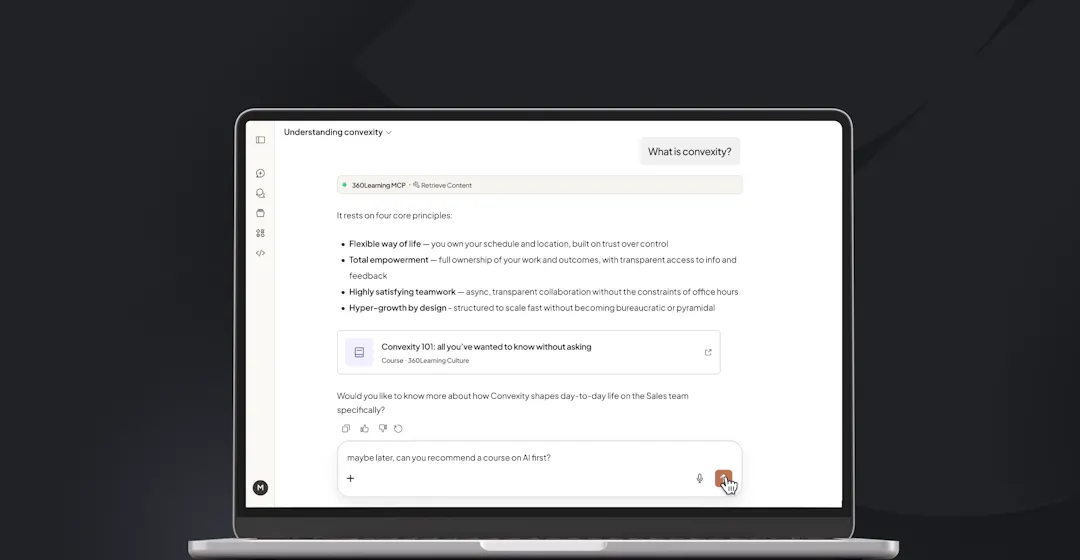
Or consider another interaction where a new hire is looking to get up-to-speed on navigating the company culture. In this proof of concept, you’ll see Claude surface a relevant course for a new hire on 360Learning’s company culture, Convexity:
Because these use cases are inherently user-dependent, they will rely on end user authentication, much like logging into a third-party tool with your Google Account. We are finalizing the development and testing of 360Learning’s MCP for learning in the flow of work with AI assistants and expect this to be generally available in Q3 2026.
This is where MCP gets powerful and – if the right development protocols aren’t in place – where it gets dangerous. An AI agent that can act on behalf of an admin to manage enrollment, generate reports, and automate administrative workflows would transform how L&D teams work, freeing them to spend more time on strategy.
The initial use cases here are focused on pulling data exports within an AI assistant interaction, letting admins surface insights around roles, groups, completions, and more inside broader queries. For instance, an admin workshopping next year's L&D strategy could ask their assistant a question and get an answer grounded in real training data: "Last year's new manager program had the highest completion and Relevance Scores since it launched in 2024, and survey feedback shows strong demand for follow-up check-in sessions."
While we plan to explore adding these use cases to our MCP, we are building these capabilities natively in our platform first via the AI Companion’s Insights Mode and Action Mode. Because the non-deterministic nature of LLMs means an agent could, in theory, execute an unintended bulk deletion or data manipulation, we are building these capabilities natively first to ensure they meet our enterprise-grade standards of security, access, and quality.
Because the non-deterministic nature of LLMs means an agent could, in theory, execute an unintended bulk deletion or data manipulation, we are building these capabilities natively first to ensure they meet our enterprise-grade standards of security, access, and quality.
When we begin to explore adding these capabilities to our MCP, they will be built on our API platform which is governed through enterprise-grade authentication standards. Our investment in the foundational security layer, access controls, and validation mechanisms will ensure we maintain enterprise-grade quality across platforms.
The internal experts who build learning content are an audience MCP can also serve directly. The vision here is to let authors and subject-matter experts generate learning content from any source material through their AI assistant. This means turning a product spec, a recorded session, or an expert's notes into structured course material in a fraction of the time it takes today.
The vision here is to let authors and subject-matter experts generate learning content from any source material through their AI assistant.
Because creating content is a write action, we're approaching it deliberately. The first capability we envision is intentionally low-risk: generating a draft course without the ability to publish it. The AI does the heavy lifting of assembling a first draft, while a human author always reviews, refines, and decides what goes live. This keeps a person in the loop on anything learners ultimately see, and gives us a safe, well-scoped entry point into write capabilities — one we can build on as the underlying security and authentication model matures.
MCP is going to become table stakes for enterprise LMS platforms. The question is how it gets implemented and whether your vendor is prioritizing speed to market or reliability in production.
Here's what we'd encourage every L&D team evaluating MCP to ask:
1. What can your MCP server actually do today: read, write, or both? If a vendor says "both," ask what guardrails exist for write operations. Who authorizes them? Is there a human-in-the-loop? What happens when the AI gets it wrong?
When 360Learning releases a write use case, our customers can be confident that it will perform tasks as designed. These write actions will have guardrails and extensive quality testing to ensure unintended write actions can’t occur. It will then be up to the customer to determine if they would like to leverage this capability or not.
2. How are you handling authentication and access control? An MCP server inherits the permissions of the API it's built on and on the authorization token it’s called with. If that API operates with admin-level privileges by default then every AI agent connected to it has admin-level access. That's a security architecture problem, not a feature.
At 360Learning, we are designing the learning in the flow of work use case to require end user authentication similar to when you use Gmail to authenticate to a third-party app.
For any admin-oriented use case, our API team will be implementing appropriate API credentials to ensure high levels of security.
3. Which AI models does it support? MCP is model-agnostic by design. But implementation details matter. Ask whether the server has been tested across Claude, ChatGPT, Microsoft Copilot, SAP Joule and other enterprise AI tools. Has the vendor built evaluation frameworks to ensure consistent behavior across models?
4. Is this production-ready or a proof of concept? There's nothing wrong with a beta, but it’s important for vendors to be transparent about when products are still in development and testing. That’s why we clearly mark AI features that are in the final stages of development with a ‘beta’ label. We want customers to be able to leverage new AI innovation while having transparency around where it is in the development cycle.
As engineers focused on building for L&D, we are genuinely excited about the possibilities in this new era.
For decades, the LMS has been a destination that L&D teams had to spend a lot of time and effort driving people to. For years, the industry has talked about ‘learning in the flow of work,’ but it was overwhelmingly about reaching learners with notifications across platforms.
With MCP, that changes fundamentally. Your LMS becomes part of a vital context layer that AI assistants can query, surface information and content from, and – eventually – act on wherever work happens. For learners, learning isn’t a separate activity to be assigned but is surfaced in the moment of need. For admins, MCP will support the transformation to a strategic L&D function that spends more time enabling business performance than chasing completion rates.
With MCP, that changes fundamentally. Your LMS becomes part of a vital context layer that AI assistants can query, surface information and content from, and – eventually – act on wherever work happens.
It’s a massive shift. And it’s one that plays directly into what we’ve always believed at 360Learning: the way L&D can fuel business performance is by unlocking internal expertise at scale. MCP enables L&D to deliver that expertise at the moment it’s needed. That’s the power of collaborative learning.
This is the first in a series of engineering-led posts where we'll pull back the curtain on how we build AI for enterprise learning. Less hype. More substance. That's how we think this industry moves forward. If you're an L&D leader evaluating MCP — or an IT team being asked to vet LMS vendors' AI claims — we'd love to hear what questions you're grappling with.
See how 360Learning can work for you.
A 15-minute conversation with an expert, fully tailored to your needs. No commitment, completely free.
By providing your contact info, you agree to receive communications from 360Learning. You can opt-out at any time. For details, refer to our Privacy Policy.
 Our weekly newsletter of the best insights from L&D peer to L&D peer.
By providing your contact info, you agree to receive communications from 360Learning. You can opt-out at any time. For details, refer to our Privacy Policy.